 en
Regulation (EU) 2023/1542 · Art. 77
The battery passport is becoming mandatory. You'll be ready first.
From 18 February 2027, e-bike and e-scooter batteries, industrial batteries above 2 kWh and vehicle batteries need a digital battery passport with a QR code – the EU's first Digital Product Passport (DPP). Here you create it in minutes, publish it and keep it up to date.
- 1,284 manufacturers in the directory
- Hosted in Germany
- Mandatory fields per battery type
EU Battery Regulation · passport mandatory from 18/02/2027
113 days until the obligation applies
The starting point
The battery passport is mandatory – the data sits elsewhere
Three things make the battery passport hard for importers and small manufacturers. All three arrive together on 18 February 2027.
One passport per battery, not per model
Every single battery you place on the market needs its own passport with a unique identifier and QR code. With hundreds of packs a year, that no longer works by hand.
The manufacturer has the data
Cell chemistry, capacity, materials and recycled content are known only to the cell or pack manufacturer, often in Asia. You have to request, check and enter them.
Market surveillance can check at any time
Without a complete passport the battery is not compliant. Authorities see what is missing straight from the QR code and may also view the protected data.
- days until the passport duty
- 113 days until the passport duty
- access levels under Annex XIII
- 3 access levels under Annex XIII
- of the manufacturers in our directory are based in China
- 61% of the manufacturers in our directory are based in China
This is exactly where Batterypass Online comes in: one form per model, manufacturer data from the directory, a passport and QR code per battery.
Manufacturer directory
Battery manufacturers from around the world – already listed
Batterypass Online comes with its own directory of battery manufacturers and pack assemblers that grows every day. Type the manufacturer name and we suggest address, website and known battery models. You only check instead of typing everything.
- verified manufacturers and pack assemblers
- 1,284 verified manufacturers and pack assemblers
- countries
- 57 countries
- battery models
- 9,873 battery models
Live from our database. Every entry is checked automatically.
Most entries come from
- China 777
- United States 130
- Germany 122
- India 23
- France 20
- Netherlands 17
- United Kingdom 17
- Canada 14
- Türkiye 14
- Japan 10
- Sweden 9
- Switzerland 9
Who it is for
Who is this for?
Importers & own brands
Whoever first places a battery on the EU market is responsible, including retailers selling under their own brand.
E-bike, e-scooter, e-moped
Light means of transport (LMT) batteries need a passport from February 2027 regardless of capacity.
Home storage & industrial
Stationary storage and industrial batteries above 2 kWh need one passport per individual battery.
Second life & remanufacturing
Repurposing or remanufacturing a battery means a new passport linked to the original one.
In four steps
How it works
- 01
Create the model
One form per battery model, structured by the data blocks of Annex XIII. Mandatory fields per category.
- 02
Import serial numbers
One by one, as a range or via CSV. Every battery gets its unique identifier.
- 03
Publish & print
QR code and label per battery. The passport page is public immediately, protected data only for authorised viewers.
- 04
Keep it current
Add status, condition data and documents over the lifetime. Every change is versioned and verifiable.
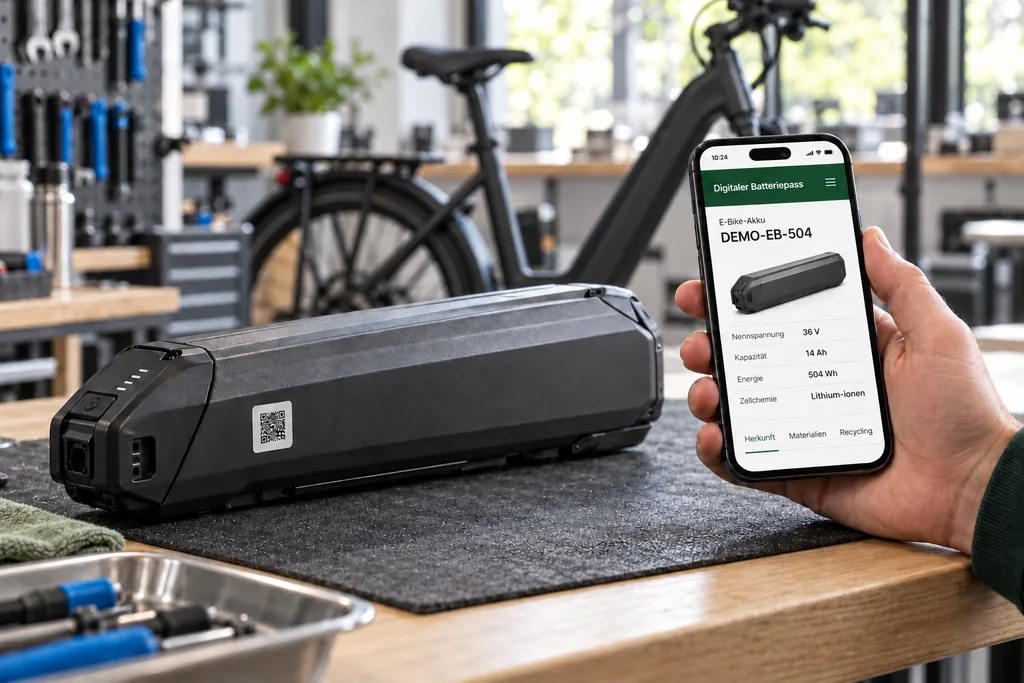
One scan at the device – everything that matters, right there.
The QR code leads to the passport page with manufacturer, model, chemistry, capacity and safety information. Workshops, inspectors and recyclers see more with their access level.
View sample passportProduct preview
How you work with Batterypass Online
Three views from the app, shown with the sample passport for a 10 kWh home storage system. All values are sample data.
- Identifiers & product data 10 public 3 protected
- Labels & conformity 5 public 1 protected
- Materials & composition 3 public 1 protected
- Circularity & resource efficiency 4 public 4 protected
- Performance & durability 13 public 14 protected
Mandatory fields complete · Ready to publish
Features
What's included
Only the mandatory fields
You fill in exactly what your battery type requires from February 2027. Before publishing we check that everything is complete.
Three access levels
Public, authorities, legitimate interest, exactly as Annex XIII defines them. Authorised parties request access on the passport page.
QR code, label & engraving
QR per battery as PNG, SVG, PDF, DXF and EPS – ready for label printers and laser engravers, in millimetres, with quiet zone and inverted for dark surfaces. Label PDF with collection symbol, ZIP for whole batches.
Go to QR StudioVersions & integrity
Every publication is a version with a checksum. Anyone reading the passport can verify it is untouched.
Involve suppliers
Request missing data from the manufacturer via a link, in all 24 EU languages or in Chinese.
Permanently available
A passport must stay reachable until recycling. We host in Germany and hand out your data as JSON at any time.
New · QR Studio
One code, every variant. Ready for printers, lasers and 3D printing.
You choose what the QR code is for. The studio sets size, quiet zone and format to match, shows you a true-size preview and checks that the code stays readable. No graphics software, no prior knowledge.
What do you need the code for?
Settings
Size including quiet zone. For batteries we recommend at least 15 mm, so the code stays readable for years, even with scratches.
PDF at true size – for a print shop or office printer.
Preview
25.0 × 28.9 mm
https://batterypass-online.eu/en/demo
Check
- Module size 0.68 mm – easily readable.
- i Readable from up to about 30 cm away.
- i Test: scan the preview with your phone – it opens the sample passport.
Every format your machine understands
- PDF – vector at true size Recommended
For Trotec and Epilog printer drivers, print shops and label services.
- SVG – vector, single path Recommended
For LightBurn, xTool, Glowforge, Inkscape and Illustrator. Dimensions in millimetres.
- DXF – CAD and laser
Closed polylines in mm on the layer "QR". For Trotec, Epilog, LightBurn, AutoCAD.
- EPS – PostScript
For CorelDRAW, Illustrator and older engraving software.
- PNG – raster image
For label printers, office documents and the web. Resolution selectable.
- STL – 3D model
For PrusaSlicer, Bambu Studio, Cura and OrcaSlicer: 2.0 mm plate, modules raised 0.8 mm.
Share without an account
A link for the print shop or supplier: they download the files with exactly these settings, no account needed. Valid for 30 days, revocable at any time.
- Preview in millimetres You see the label at the exact size it will be printed, with the serial number above or below the code.
- Readability is checked Module size and scanning distance are shown right beside it. For batteries we recommend at least 15 mm, so the code stays readable for years.
- Works on dark casings too The inverted variant makes the code readable on black plastic or anodised aluminium.
- Vector at true size PDF and SVG in millimetres, text as outlines. Load straight into LightBurn, xTool, Glowforge, Trotec or Epilog without scaling.
- 3D printing without rework STL for PrusaSlicer, Bambu Studio, Cura and OrcaSlicer: 2.0 mm plate, modules raised 0.8 mm.
- Share without an account One link for the print shop or supplier. They download exactly your settings. Valid for 30 days, revocable at any time.
- The code stays the same It always leads to the passport page. New versions of the passport don't change it, so printed labels stay valid.
Pricing
Pricing
Clear prices, no setup fee. Pay monthly, or yearly with two months free. All prices net.
Pilot
free
For trying it out. Passports carry a test-data notice, no registry export.
- 1 battery model
- 10 passports per year
Starter
€59.00 / month
or €590.00 / year – 2 months free
Everything for the first real passport: QR code, passport page, access levels, export for the EU registry.
- 5 battery models
- 500 passports per year
Business
€149.00 / month
or €1,490.00 / year – 2 months free
Plus supplier forms, API and webhooks for shop and ERP integration.
- 15 battery models
- 5,000 passports per year
Reverse charge for businesses in the EU (provide your VAT ID). Monthly plans cancel monthly, yearly plans at the end of the year.
Frequently asked
Frequently asked questions
Registration, data storage and costs.
Is the battery passport a Digital Product Passport (DPP)?
Yes. The battery passport is the EU's first mandatory Digital Product Passport. Regulation (EU) 2023/1542 requires it in Article 77; the Ecodesign Regulation (EU) 2024/1781 later applies the same framework to further product groups. Creating a battery passport today meets the DPP obligation for your batteries.
Which batteries need a passport?
Batteries for e-bikes, e-scooters and e-mopeds, industrial batteries above 2 kWh (for example home storage) and vehicle batteries placed on the market from 18 February 2027. The obligation check tells you in two minutes whether your product is affected.
Do I have to register my passports with the EU?
Yes. For every battery, the passport address is entered in the EU registry for digital product passports (Art. 77(10)). The registry stores only this identifier, not the passport itself.
Do you handle the registration?
Only the economic operator may register, with their own EU Login. We create the finished upload file, check it in advance and add the returned registration ID to your passport.
What do I need for the EU registry?
An EU Login for your company, verification as an economic operator (for example by VAT ID) and a qualified electronic seal. Registration is free; only the seal costs money.
Can I register today?
Yes, you can create and publish your battery passports today. They can be uploaded to the EU registry as soon as the Commission has published the data catalogue for batteries – your finished passports are then ready right away.
Where is my data stored?
On our servers in Germany, backed up daily to a second location. Only the passport address goes to the EU.
What happens to the passports if I cancel?
They remain available free of charge for at least 15 years and until the battery is recycled, as Art. 77(8) requires. You can export all data at any time. Only changes and new passports need a plan again.
How do I pay?
Monthly or yearly in advance by card or SEPA direct debit via Stripe. Cancellable to the end of the billing period. Above the annual quota each additional passport costs a one-off EUR 0.25 (Starter), 0.12 (Business) or 0.06 (Pro) – or buy a cheaper extra pack in advance.
Do I need a separate passport for every single battery?
Yes. Art. 77 requires one passport per battery, not per model. You enter the model data once; we generate the passports per serial number from it, one by one, as a number range or via CSV.
My manufacturer is in China and does not reply. What now?
Send a data request via a link (Business plan and up). The form is available in Chinese and the manufacturer needs no account. Many manufacturers are also already listed in our directory with address, website and models. Responsibility for the passport stays with whoever places the battery on the EU market.
Can I take over data from Excel?
Yes. You import serial numbers via CSV, and simple model values via CSV with the official field names too. Lists, documents and manufacturer details are maintained in the wizard.
Which formats is the QR code available in?
PNG (300 to 1200 dpi), SVG, PDF, DXF and EPS – at any size from 8 to 200 mm, with the quiet zone required by ISO/IEC 18004 and optionally inverted for dark materials. Laser engravers such as LightBurn, xTool, Trotec or Epilog load SVG and DXF directly; PNG and PDF go to label printers and print shops.
Ready for 2027?
Create your first battery passport today.
The Pilot plan is free. Passports carry a test-data notice until you switch to a paid plan.